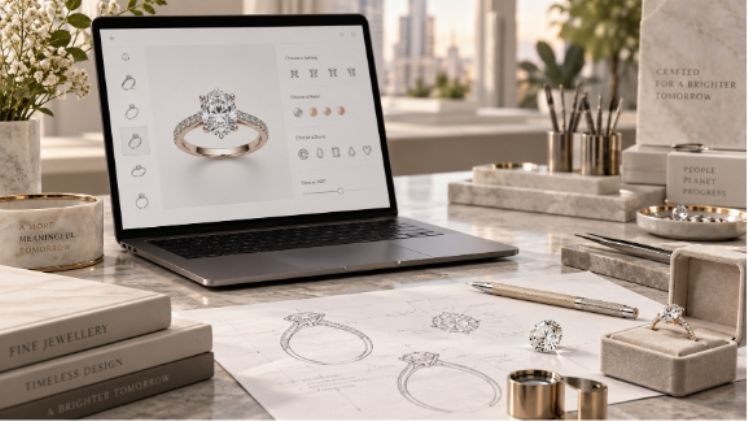
Custom engagement rings were once associated mainly with traditional bespoke jewellery appointments, long consultations and a process that could feel difficult to understand from the outside.
That is changing.
Digital tools now allow customers to explore settings, diamond shapes, precious metals and price differences before they ever speak to a jeweller.
This does not remove craftsmanship from the process. Instead, it makes the early stages of custom design more transparent and easier to navigate.
Customers Can Explore Before They Commit
One of the biggest advantages of digital jewellery tools is the freedom to explore privately.
Customers can compare several options without feeling pressured to make an immediate decision.
They may want to see:
- how an oval diamond looks compared with a round diamond;
- whether yellow gold suits the design better than platinum;
- how a solitaire compares with a hidden halo;
- what happens to the price when the centre-stone size changes; or
- whether a more detailed setting still fits the budget.
This kind of exploration can make the final decision feel much more considered.
Ring Builders Make Complex Choices Easier
An engagement ring combines several different design elements.
Without guidance, the number of choices can quickly become overwhelming.
A good ring builder breaks the process into smaller steps so the customer can focus on one decision at a time.
For example:
- Choose the setting.
- Select the precious metal.
- Choose the centre stone.
- Compare specifications.
- Review the finished combination.
This structure gives customers a clearer understanding of how the ring is built.
The Centre Stone Can Be Chosen More Carefully
Digital tools are particularly useful when selecting a diamond because individual stones can be compared using detailed specifications.
Customers may be able to review:
- shape;
- carat weight;
- colour;
- clarity;
- measurements;
- price; and
- grading information.
This creates a more transparent buying experience than simply selecting a finished ring without knowing much about the centre stone.
Price Transparency Helps Buyers Prioritise
Customisation becomes much easier when customers understand how each choice affects the price.
For example, one buyer may decide that a larger diamond is more important than choosing platinum. Another may prefer a smaller centre stone with a more detailed setting.
Digital pricing tools make these trade-offs easier to understand.
Instead of treating the ring as one fixed price, customers can see how the individual components contribute to the total.
Visualisation Reduces Uncertainty
One challenge with custom jewellery is that the final ring may not physically exist when the customer places the order.
Digital previews, renders and product imagery help reduce that uncertainty.
Even a simple visual comparison can help someone understand the difference between:
- white gold and yellow gold;
- round and oval diamonds;
- solitaire and trilogy settings;
- high and low settings; or
- plain and pavé bands.
As visualisation technology improves, this part of the custom jewellery process is likely to become even more useful.
Custom Does Not Always Mean Starting From Scratch
Many customers like the idea of a custom engagement ring but do not necessarily want to design every element from a blank page.
Digital tools allow them to begin with an existing setting and personalise the parts that matter most.
This might include:
- changing the centre-stone shape;
- choosing a different carat size;
- selecting another metal;
- adjusting the band width;
- adding a hidden halo;
- changing claw details; or
- choosing different side stones.
This middle ground between a finished stock ring and a completely bespoke design is one reason digital ring builders have become so useful.
Modern Ring Builders Can Support Better Decisions
Online tools work best when they are designed to educate rather than simply display products.
A customer should be able to understand why one option differs from another and whether the extra cost provides a meaningful benefit.
For example, a buyer may not need the highest possible clarity grade if a lower grade is already eye-clean.
Likewise, the largest possible diamond may not create the best-looking ring if the proportions feel unbalanced on the hand.
Digital comparison can help make these trade-offs clearer.
Human Expertise Still Matters
Technology can simplify the process, but it cannot replace every part of jewellery design.
Customers may still need expert advice about:
- setting height;
- stone proportions;
- claw placement;
- wedding-band compatibility;
- band thickness;
- durability; and
- long-term maintenance.
This is why the strongest digital jewellery experiences combine online tools with access to experienced professionals.
Online Ring Design Is Useful for Couples Shopping Together
Not every engagement ring is chosen as a surprise.
Many couples now make the decision together.
Online tools make that easier because both people can compare options at home, save ideas and discuss what they prefer without the pressure of a showroom appointment.
That can make the process more collaborative and reduce the risk of choosing a design that does not suit the person who will wear it.
Digital Tools Can Also Help With Budget Planning
Engagement ring budgets can vary significantly, so flexibility matters.
A ring builder can help customers see where they can adjust the design without abandoning the overall look they want.
For example, a buyer might:
- change the centre-stone size;
- choose 14K instead of 18K gold;
- select a simpler band;
- reduce side-stone weight; or
- prioritise cut quality over higher clarity.
This makes the design process feel more practical and less intimidating.
The Nura Lab Ring Builder Reflects This Shift
Jewellery businesses are increasingly combining digital selection with professional craftsmanship.
The Nura Lab Ring Builder is an example of this approach, allowing customers to compare settings and centre stones online while still having access to guidance for more detailed design questions.
This type of hybrid model gives buyers the convenience of online shopping without removing the human expertise behind the finished jewellery.
Custom Engagement Rings Are Becoming More Accessible
Digital tools have helped remove some of the mystery from custom jewellery.
Customers can now understand the design process more clearly, compare options before making contact and arrive at a consultation with a much better idea of what they want.
This can make custom design more accessible to people who might previously have assumed it was too complicated or reserved only for very high budgets.
The Future Is Likely to Be Hybrid
The future of engagement ring design is unlikely to be entirely digital or entirely traditional.
Instead, the strongest experience will probably combine both.
Customers will use technology to research, compare and configure their ideas, while jewellers will continue to provide the expertise needed to refine proportions, improve durability and turn the digital concept into a finished piece.
This combination gives buyers more control without sacrificing craftsmanship.
Technology Is Making the Buying Process More Personal
The real value of a ring builder is not simply convenience.
It gives customers a more active role in creating one of the most personal pieces of jewellery they may ever own.
By making design choices easier to understand, digital tools are helping engagement ring buyers move from passive selection toward genuine participation in the creative process.